

Let’s get real about traditional whole group math instruction, because it’s not working the way we think it is. If you’re anything like most teachers, your math block probably looks a little something like this:
This way of teaching is structured. It’s familiar. It’s what we were taught as kids.
But also… it’s not working. And deep down, you already know it.
So what do you do to fix it? You already feel stressed, overwhelmed, and exhausted just trying to get through the day.
The good news is, you don’t have to change who you are as a teacher. You just need to alter your approach to teaching math, and I’m here to help you do it!
This is something I break down in a much deeper way inside my book, but first, let’s talk about why whole group instruction isn’t working in today’s classrooms.

Growing up, I only remember being taught in whole groups. There was never a teacher table with small groups and differentiated lessons.
But our teachers weren’t bad teachers… and neither are you!
Whole group instruction isn’t failing because of who’s teaching it. It’s failing because it was never designed to reach every student in the first place.
Traditional whole group instruction delivers the same content:
…to a room full of students who are anything but the same.
In any given math lesson, you likely have students who are:
And yet, we teach them all the exact same way.
Even when you’re doing everything “right” and following the lesson plan, only part of your class is truly getting it.
Best case scenario? Some students are engaged.
Worst case? Students completely shut down.
Usually, it’s a mix of both.
Now let’s talk about engagement. Over the last decade, student engagement has been a bit of a buzzword in the education world. But what does that really mean? What constitutes a student being engaged?
A student might be sitting still, looking at you, and nodding along, but that doesn’t mean they understand.
Even when students are “actively involved,” it’s still so easy for them to get distracted, miss key steps during instruction, and lose track of their thinking.
And once that happens? They’re done.
I’ve seen it so many times in my own classroom experience… sometimes all it takes is one distraction (whether a student behavior, fire drill, or parent popping in with birthday cupcakes) and the entire lesson is derailed.
In my opinion, student engagement is when kids are actively participating in the learning.
They’re having mathematical conversations, asking questions, and working with the concept in multiple ways… using hands-on activities, independent activities, and applying the learning to real-world scenarios.
Engagement isn’t something stiff or quiet… it’s the buzz of kids learning and conversing.
After whole group lessons, students typically move into independent work (AKA… workbook time). This is where the gaps become even more obvious.
You walk around.
You check in.
You try to help as many students as possible.
But realistically? You cannot reach every student.
There are always students who:
And when mathematical misconceptions aren’t caught right away… they stick. (Hello, future math struggles!).
Not only that, but students get frustrated, overwhelmed, and start shutting down. And just like us as adults, when we feel that way about something, it’s hard to find the motivation to want to do it.
This is one of the biggest shifts I had to make in my own teaching, and it’s something I walk through step-by-step inside my guided math framework.
We know that timely, specific feedback is one of the most powerful ways to improve student learning. Students need to know when they’re on the right track and when they need to try something different and think about the concept in a different way.
But during whole group instruction? It’s nearly impossible to provide that level of support to every student.
Even during independent work, when you’re trying to give feedback and spend some 1:1 time with students you’re still:
This time is full of constant interruptions, and let’s be honest… it’s hard to focus on each individual student and give them the attention they need.
More often than not, it’s the students who need the most help who get missed during this time.
Either they start acting up out of frustration and your attention is on their behavior (not their math work), or they sit quietly at their desk, staring at their work in complete overwhelm. But they’re being quiet and not outwardly asking for help, so you move to the next most pressing need.
I know it’s hard to think of it that way, but as teachers, we can also find ourselves in survival mode, and that’s just how it tends to go. I’ve been there and I get it! And again… you’re NOT a bad teacher.
With all of this being said, you’re probably thinking, “Okay Marcy, do I need to ditch whole group instruction altogether?!”
The answer to that is… NO. Whole group instruction isn’t all bad.
In fact, it can actually be really effective and powerful if you do it the right way.
It can:
It was just never meant to carry the entire weight of your math instruction.
When we rely on it to do that:
If it’s so clear that traditional whole group math instruction isn’t working, why are we still doing it this way?
Because it’s what we’ve always known.
It’s how we were taught as kids.
It’s what many teacher education programs still teach.
It’s how many classrooms still operate.
It feels structured and controlled.
But “familiar” doesn’t always mean “effective.”
More and more teachers are starting to realize that there has to be a better way to reach every student.
So if you’ve ever thought:
You’re not alone. I actually break down 5 specific challenges of whole group instruction in more detail here.
But the most important thing is, there is a solution.
There is a way to teach math that:
But it requires a shift in how we think about instruction. Once I made this shift in my own classroom, everything changed, and that’s why I’m so passionate about teaching other educators to make it too.
It’s how I’ve been teaching in my own 2nd grade and math intervention classrooms for 10+ years.
It’s what I’ve been training teachers on through my professional development course and sessions.
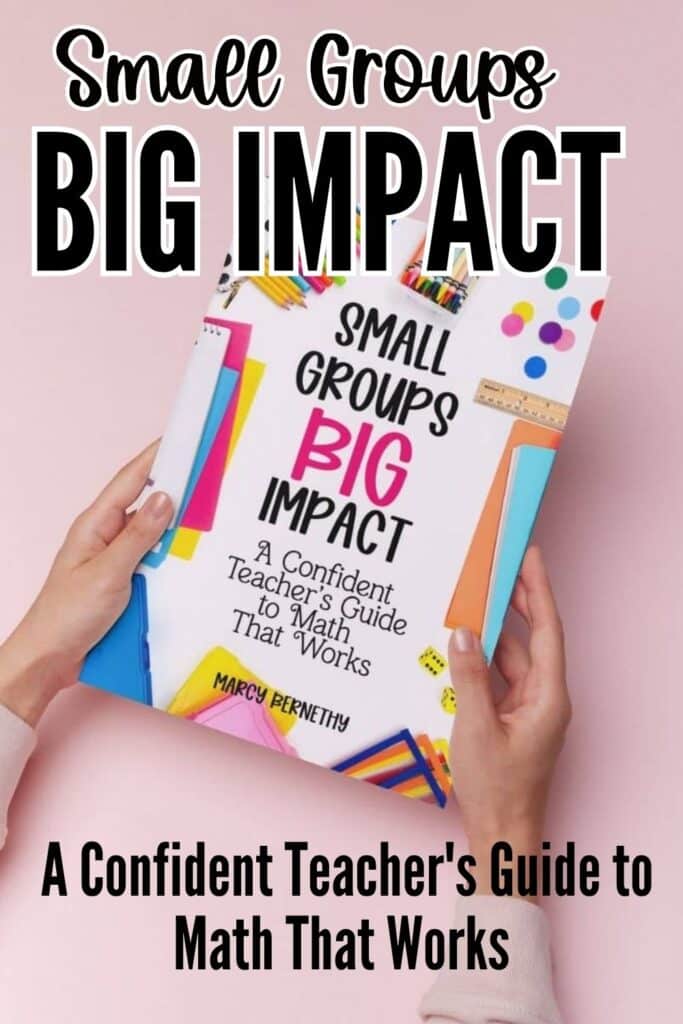
And now, I’m sharing the exact step-by-step plan to teach math the more effective way… the less stressful way… the GUIDED MATH way inside my new book, Small Groups, Big Impact.
This book combines everything I’ve tested, tweaked, and learned as an elementary math teacher and professional development presenter.
I’ll teach you exactly how to implement guided math (including strategic whole group and small group instruction) so you can reach every student and help them succeed.
If you’re ready to stop feeling like you’re failing your students and finally have a clear, simple plan that works, this book will walk you through exactly how to do it.