
Have you ever felt like your math curriculum is just NOT working? You taught the lesson exactly like the curriculum told you to. You used the slides, modeled the examples, had students complete the workbook page, and then sat down to check their work during your plan period and thought to yourself… “Well, that didn’t work. They clearly don’t get it.” And suddenly you’re searching for supplemental math resources for teachers that might help you reteach the concept tomorrow.
Half the class is completely confused, a few students are on track, and a handful are right in the middle… teetering around “kinda-sorta getting it.”
You think back on your lesson and realize it might have moved too fast or lacked hands-on practice before students were ready for a page full of problems. Or maybe the curriculum just made a simple math concept way more complicated than it needed to be. We’ve all been there!
Here’s the thing… your math curriculum is a tool. It’s not the teacher. YOU ARE.
And when your elementary math curriculum isn’t giving your students what they need, you don’t necessarily have to throw it out and start over.
You probably just need to figure out what isn’t working, what you can adjust, and which supplemental math resources can help fill the gaps.
Read on to see the process I use.
Before you open Pinterest and start searching for supplemental math resources for teachers, take a minute to figure out what the actual problem is.
Ask yourself:
What isn’t working about this lesson for my students?
Maybe…
Those are all very different problems, which means they need different solutions.
If students don’t understand regrouping because they don’t understand that 10 ones can be composed into a ten, another worksheet with 20 regrouping problems probably isn’t going to fix it.
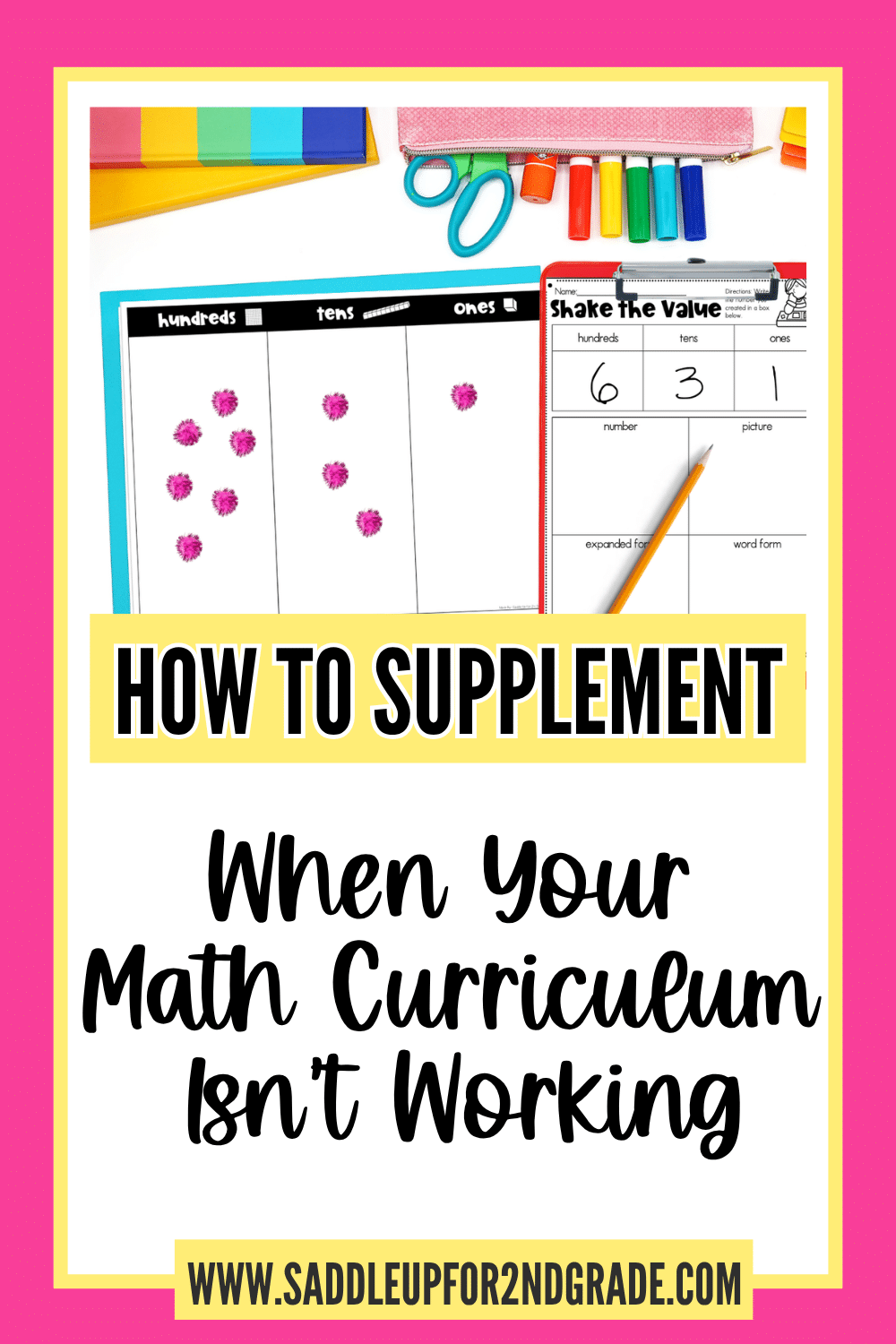
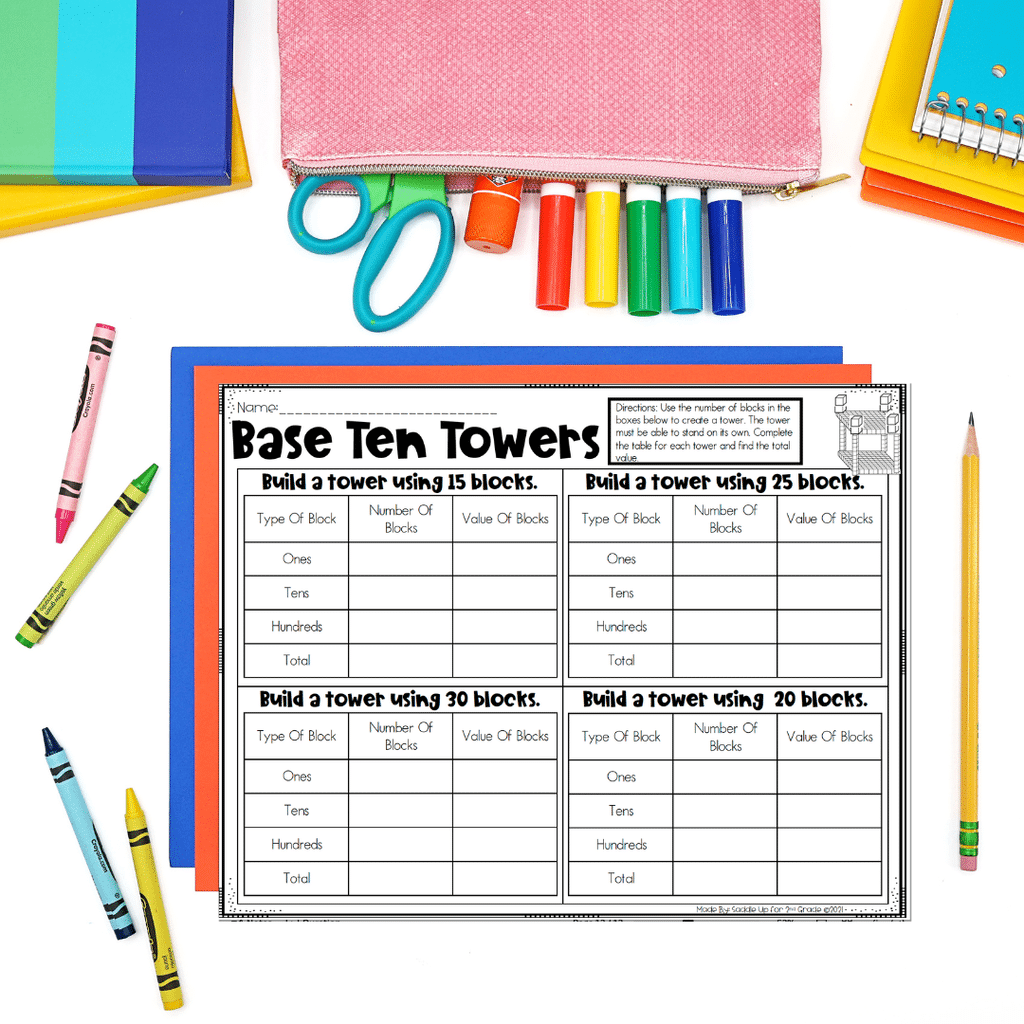
They may need to back up, grab some base-ten blocks, and actually build the numbers.
On the other hand, if students understand the concept but just need more practice, you probably don’t need to reteach the entire lesson. A game, set of task cards, or quick partner activity might be exactly what they need.
Don’t supplement just because you don’t like the curriculum lesson. Supplement to solve a specific problem.
Once you’ve figured out what isn’t working, go back to the standard.
Ask yourself:
What do my students actually need to know and be able to do?
This is where backward planning can save you SO much time.
Instead of looking at the curriculum and thinking you have to get through all 17 pages of the lesson, look at the standard and identify the actual teaching points your students need to understand.
Let’s go back to regrouping as an example.
Maybe today’s lesson has students solving two-digit addition problems using a specific strategy.
But when you look at their work, you realize the strategy isn’t actually the problem.
Your students don’t understand why 10 ones can be regrouped as 1 ten.
Bingo… now you know what you need to teach.
You don’t need to scrap your entire math curriculum.
You need to fill that specific gap, and that’s where I use a really simple decision-making process.
When I look at a curriculum lesson, I don’t automatically assume I need to use every single piece exactly as it’s written. Let’s be honest… curriculums give you a lot of activities and stuff… there’s no way you can get through it all (and it’s also not always that great!).
I also don’t automatically toss it aside and create something brand new from scratch.
Instead, I ask:
Do I need to KEEP IT, TWEAK IT, or SUPPLEMENT IT?
If the curriculum lesson gives your students exactly what they need… USE IT!
You do not get bonus teacher points for staying up until 10 p.m. creating a cuter version of something you already have.
If the lesson explains the concept clearly, provides meaningful practice, and works for your students, let it do its job.
Check that box and move on!
Sometimes the curriculum lesson is almost what you need.
You don’t need a replacement. You just need to make a small adjustment.
Maybe you:
Those little tweaks can make a HUGE difference without creating a bunch of extra work for you.
Let’s say the curriculum gives students 15 addition problems on a worksheet.
The math itself is fine, but your students are over it.
Cut the problems apart and turn them into task cards.
Put them around the room.
Have students solve them on whiteboards.
Let partners roll dice to determine which problem they solve next.
Same math. Same learning goal.
You didn’t spend two hours creating a brand-new lesson.
You just changed how students interacted with the math.
Then there are times when the curriculum simply doesn’t have what your students need.
THAT’S when supplemental math resources for teachers can be incredibly helpful.
Maybe your students need:
Notice that we’re not supplementing just for the sake of adding more stuff.
Because trust me… your math block does NOT need more random stuff.
We’re choosing a resource because we’ve identified a specific need that our curriculum isn’t meeting.
That’s the difference between purposeful supplementation and just adding more to your plate.
There are approximately 8 bazillion math activities on the internet… okay, maybe that’s an exaggeration, but it sure can feel like it when you’re desperately searching for just the right activity to help make a math concept click for your students.
We shouldn’t be trying to collect as many math resources for teachers as we possibly can… we should be looking for the right resource for the problem we’re trying to solve.
So before you print, laminate, cut, or spend 45 minutes scrolling Pinterest, think about what your students need this resource to help them do.
If students need to understand the concept, look for something hands-on that uses manipulatives or visual models.
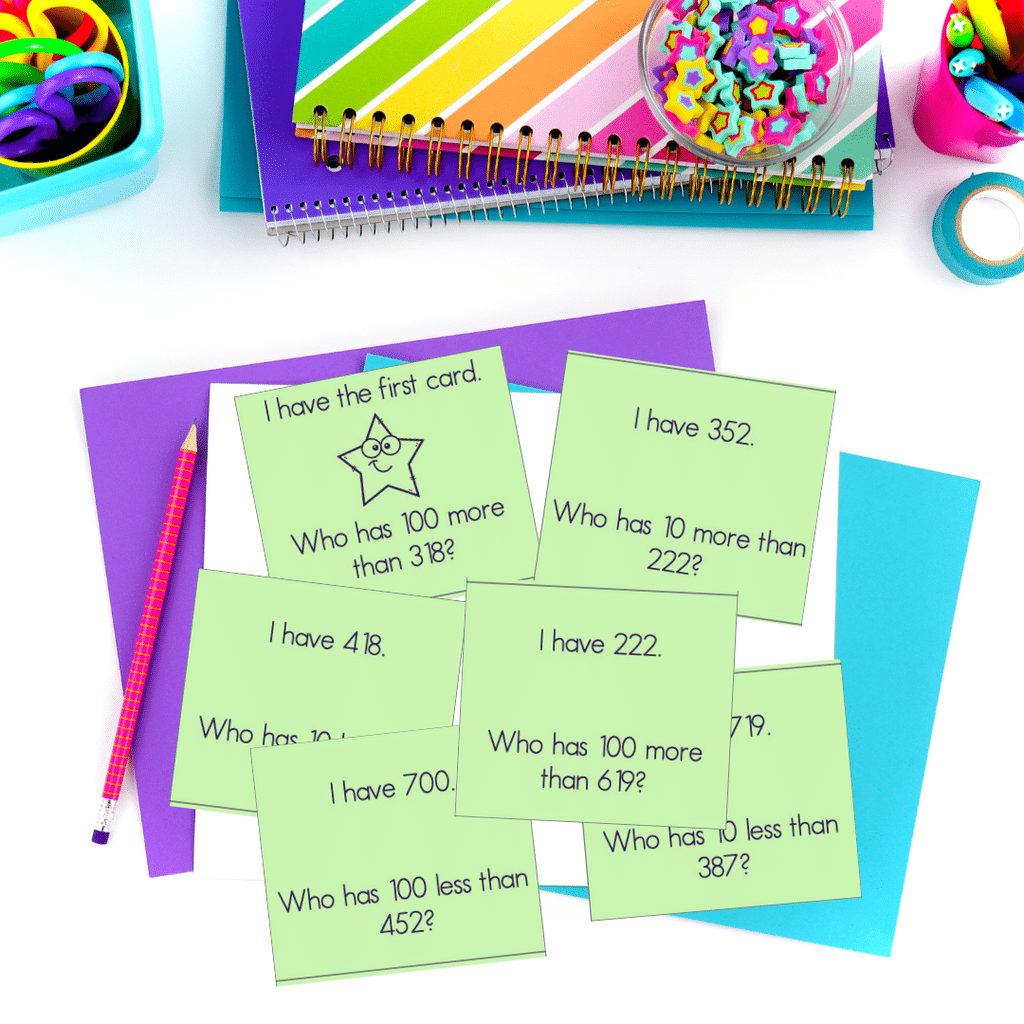
If they understand the concept but need more practice, try a game, task cards, partner activity, or center.
If a few students need reteaching, look for something you can use at your small group table.
If students are forgetting previously taught skills, add spiral review instead of reteaching an entire unit.
If students have already mastered the skill, look for ways to extend their thinking instead of simply giving them more problems.
This can save you from downloading a whole lot of cute activities that don’t actually solve the problem you’re having.
Here’s another thing I want you to remember… just because six students didn’t understand today’s lesson doesn’t mean your entire class needs to spend three more days on it.
This is where small group instruction becomes SO helpful.
Let’s say you taught a place value lesson and your exit ticket shows:
Instead of reteaching the entire lesson to everyone, you can use your small group time to address those needs.
Pull the six students who need additional support and use base-ten blocks and a place value mat.
Let the students who are ready continue practicing or move into the next part of the skill.
Challenge the students who have mastered it by changing the numbers, asking them to compare representations, or having them explain their reasoning.
Your curriculum can still help guide what you’re teaching.
Your small groups give you a place to respond when students need something different.
But what happens when you’re required to use a specific curriculum?
I’ve got good news… you can absolutely use guided math and small group instruction alongside the curriculum your school requires. I break down exactly how that can work in my post about using guided math with any curriculum.
You don’t have to choose one or the other… they can work together!
Once you’ve identified the gap, finding something to fill it shouldn’t become another hour-long project.
We’ve all done this…
You need ONE quick place value activity.
Then 45 minutes later, you have 17 tabs open, three things in your TPT cart, two Pinterest boards you forgot you had, and somehow you still haven’t found what you actually need. And now… your planning period is over.
This is one of the reasons I created the Inner Circle Math Membership.
I wanted teachers to have a place where they could quickly find supplemental math resources that work alongside the curriculum they’re already using.
So if your curriculum lesson is too abstract, you can find something more hands-on.
If your students need another round of practice, you can grab a center or game.
If five students need reteaching, you can find something to use at your small group table.
If students need independent practice while you’re teaching that small group, you’ve got options for that too.
The Inner Circle includes math resources for 1st-3rd grade organized by grade level and skill, so you can start with what your students need instead of scrolling through a giant pile of random activities.
We aren’t replacing your elementary math curriculum… we’re giving you options when your curriculum isn’t enough.
Learn More About the Inner Circle Math Membership!

Your curriculum doesn’t know that six of your students still need base-ten blocks.
It doesn’t know yesterday’s lesson took twice as long as the pacing guide said it would.
It doesn’t know that your class needs one more day of practice before they’re ready to move on.
You do.
That’s why your teacher judgment matters.
So the next time a math lesson completely tanks, don’t immediately assume you need to throw everything out and start over.
Go back to this simple process:
Your elementary math curriculum can still be a great tool, but when it leaves gaps, the right supplemental math resources can help you fill them without creating an entirely new curriculum or sacrificing your entire Sunday afternoon to do it.
If you enjoyed this post, you’ll love my book, Small Groups, Big Impact.
I wrote it for real teachers like you who know small groups matter but aren’t sure how to make everything work and fit together. Instead of giving you more ideas to add to your already overflowing plate, I show you exactly how to build a guided math framework that works in a real classroom.
Whether you’re just getting started or looking to refine your current approach to small group math instruction, you’ll find practical strategies, classroom examples, planning systems, and data-driven routines you can implement right away.
Click here to grab your copy of Small Groups, Big Impact and start teaching math with more clarity and purpose.