

When you hear the term “differentiated math instruction,” what do you think of?
For a lot of teachers, it’s an immediate sigh of dread (and maybe a little panic), because they think it means they’re going to have to create completely different lessons for every level of learner in their classroom.
Well teacher friend, you can breathe a sigh of relief, because that is NOT how we differentiate math lessons around here! We are teachers. We are busy. We do not have time for that!
Differentiation doesn’t mean teaching a different lesson to every student in your classroom. It means giving students different levels of support, practice, or challenge while working toward the same learning goal.
And once you embrace that mindset, figuring out how to differentiate math becomes a whole lot less overwhelming.
Read on to learn a simple system for implementing differentiated math instruction without creating separate lesson plans for every student!
Before we talk about how to differentiate math, let’s make sure we’re on the same page about what differentiated math instruction actually means.
At its core, differentiation is about recognizing that the students sitting in your classroom aren’t all coming to you with the same background knowledge, understanding, or needs.
You might have one student who still needs manipulatives and lots of teacher support to understand a concept, another who is ready to practice it independently, and another who is ready to take that same concept a step further.
That doesn’t mean you need three completely different lesson plans though!
Instead, differentiated math instruction means adjusting the way students access, practice, or extend their learning based on what they need.
You might differentiate by changing:
Now, here’s what I want you to understand… the learning goal can stay the same for every student.
Your students may take slightly different paths to get there, but you don’t have to create an entirely different math lesson for every learner in your classroom.
Once I started thinking about differentiation this way, it felt a lot more doable.
Instead of asking, “How in the world am I supposed to plan a different lesson for all of these students?”… I started asking, “What does each student need from me to move forward with this math concept?”
That question is where effective differentiation really begins.
Let’s be honest… differentiating math can feel SUPER overwhelming. All we want to do is reach our students so they can be successful, but when you’re feeling pulled in so many directions, it can be hard to figure out just HOW you’re going to do that with the limited time you have.
When you finish a math lesson and realize…
…it can feel defeating.
You know your students need different levels of support, but you also know you can’t realistically write a separate lesson for every kid in your classroom.
And thankfully, you don’t have to.
The solution to differentiated math instruction isn’t more lesson plans.
It’s creating a structure that gives you opportunities to respond to what your students actually need.
And that’s exactly where small group math instruction comes into play.
Small groups allow you to keep your overall learning goal the same while changing the support, practice, questioning, or level of challenge you provide to different students.
Instead of trying to meet 25 different needs at the exact same time, you can bring together students with similar needs and give them targeted instruction, without creating 25 different lesson plans.
I’ll tell you from experience… that makes differentiation feel way easier!
So, how do you actually make differentiated math instruction work without spending every evening creating different lesson plans for every group?
The key is to stop thinking of differentiation as planning completely different lessons and start thinking about how you can adjust the support students receive while working toward the same learning goal.
Here’s the simple process I use.
Before you start thinking about groups, activities, manipulatives, or centers, start with the math standard.
What do your students actually need to know and be able to do?
This goes back to the backward planning process I talked about in my post on simplifying your math lesson planning process.
Start with the standard, break it apart, and identify the most important teaching points your students need to understand.
For example, maybe your students are learning to add two-digit numbers with regrouping.
Your learning goal might be for students to understand why regrouping is necessary when there are 10 or more ones and how those 10 ones can be composed into a new ten.
That’s the learning goal for everyone.
You don’t need one standard for your struggling students, another for your on-level students, and another for your advanced students.
Students may need different amounts of support to master the standard, but you’re starting from the same core math concept.
Once you know what you’re teaching, the next question is:
What do my students need from me to learn it?
And teacher friend, you don’t have to guess!
Your students are giving you information about what they understand all day long.
You can use:
You don’t need a fancy spreadsheet or a giant assessment every time you want to differentiate.
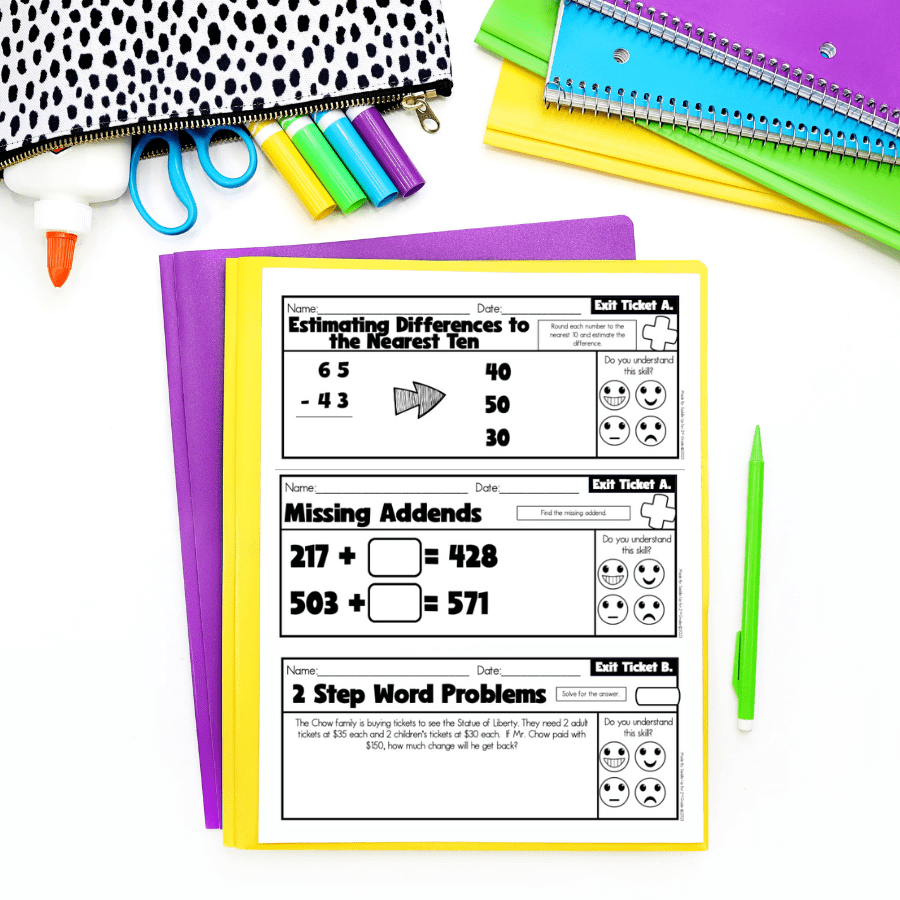
Sometimes an exit ticket with two problems tells you exactly what you need to know.
Look at the information you have and ask:
Now you have a reason for bringing certain students together in a small group.
You’re not grouping students because they’re a “high,” “middle,” or “low” math student.
You’re grouping them based on what they need right now with this particular concept.
Those groups can and should change as student needs change, and they’ll likely look different from concept to concept.
This is where differentiation gets SO much more manageable.
You don’t have to create three completely different lessons.
Instead, think about how you can adjust the support, practice, or challenge while keeping students focused on the same core math concept.
Let’s go back to our two-digit addition example.
Suppose your students are working on adding two-digit numbers with regrouping.
During your whole group lesson, everyone has been introduced to the same concept.
Now you’re ready to use small groups to respond to what you noticed.
Students who need additional support might work with you using base-ten blocks. You could choose numbers that allow them to physically compose 10 ones into a new ten while you model the process, ask questions, and connect the manipulatives to a written representation.
Students who are ready for more practice might solve two-digit addition problems using drawings, equations, or another strategy you’ve taught. You can ask them to explain their thinking and show why their strategy works.
Students who are ready for a challenge don’t necessarily need to move on to an entirely new math skill. Instead, you might deepen the learning by giving them a multi-step problem, asking them to compare two strategies, having them find and explain an error, or challenging them to justify their thinking.
Same math concept. Same overall learning goal. Different levels of support, practice, and challenge based on what each group actually needs.
It’s three different learning experiences, not three completely different lesson plans.
THAT is what differentiated math instruction can look like.
And small group instruction gives you the perfect opportunity to make those little adjustments without trying to teach 25 different lessons at the exact same time.
This is one of the reasons I’m such a huge believer in small group math instruction.
During whole group instruction, you might introduce the same concept to everyone. Then, during small groups, you can adjust your instruction based on the students sitting at your table.
You might change:
You’re not starting over and teaching a brand-new lesson.
You’re making small adjustments to meet students where they are, and those adjustments don’t always require a bunch of extra prep either!
This is where I think teachers sometimes make differentiation way harder than it needs to be.
Trust me… I’ve been there too! I was the teacher that prepped individual file folder games for every single student in my early teaching years (only for students to rip them up). Yeah… you might remember that story if you’ve followed me for a while! Let’s just say… it ended with me crying to my neighbor teacher in our shared classroom bathroom.
Anyways… let’s say you have a set of addition task cards.
You don’t necessarily need three different sets of task cards.
Maybe one group uses the task cards with base-ten blocks or a hundreds chart for support.
Another group solves the exact same task cards independently and explains their strategy on a recording sheet.
For students who need a challenge, you might have them solve each problem in two different ways, write a related word problem, or explain how they know their answer is reasonable.
One set of task cards. Three different ways to use them.
You can do the same thing with dice.
If students are practicing addition, one group might roll two wiz dice with higher numbers and add them.
Another group might use standard dice with numbers up to 6 and add those.
Students ready for a challenge might roll to create their own numbers, estimate the sum first, solve, and then compare their estimate to the actual answer.
You can differentiate with manipulatives too.
One student might need base-ten blocks to physically build a number.
Another might be ready to draw a quick model.
Another might solve with an equation and explain how the model connects to the numbers.
Sometimes differentiation can be as simple as changing the numbers you give students or the question you ask after they solve.
You don’t always need a different activity. Sometimes you just need a different way to use the activity.
If you take anything away from all of this differentiated math instruction talk, let it be this…
You do NOT have to differentiate everything in your math block.
Your students can share whole group lessons, math discussions, routines, games, centers, and independent practice.
Maybe your differentiation happens primarily at your small group table.
Maybe you provide a number line to one student and not another.
Maybe everyone completes the same problem, but one student explains how they solved it while another explains why the strategy works.
All of that counts.
You don’t need to differentiate everything. You need to differentiate where it matters.
This is exactly why I love guided math, and it’s a big part of what I teach in Small Groups, Big Impact. The book walks you through how to create a math block that gives you time to actually provide this type of targeted instruction without the rest of your classroom falling apart while you do it!

So, let’s put all of this together.
You don’t need 100 lesson plans to differentiate math.
You need:
One clear learning goal.
Data that tells you what your students need.
A few simple ways to adjust the support, practice, or challenge.
And finally…
Resources that make it easy to put your plan into action… that’s step 4!
Because even when you know exactly what your students need, you still need something for them to DO.
If one group needs hands-on practice with place value, you need the activity.
If another group needs independent practice, you need that too.
If you’re pulling a small group, you need meaningful activities the rest of your students can complete without interrupting you every 47 seconds.
And if your advanced students are ready to extend their thinking, you need something that actually challenges them instead of just giving them 10 more problems.
You could spend your planning period creating all of that yourself, but you already know I’m not going to tell you to do that!
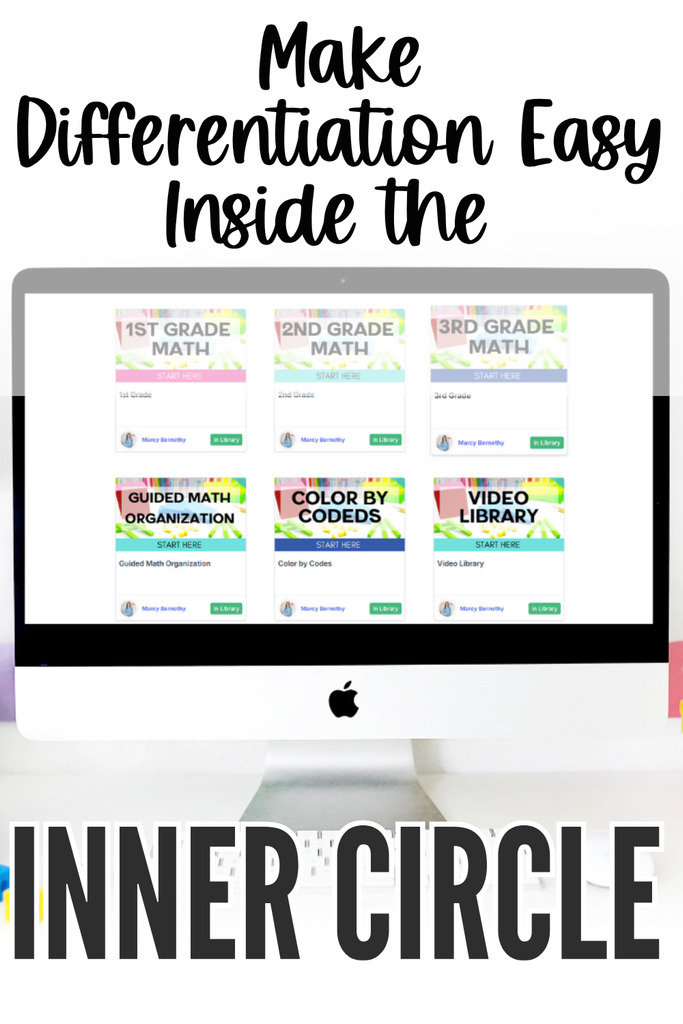
This is one of the reasons I created the Inner Circle Math Membership.
Once you figure out what your students need, I want finding the resources to be the easy part.
Everything inside the Inner Circle is organized by grade level and math skill, with resources for 1st, 2nd, and 3rd grade.
So let’s say you’re teaching place value.
You can search for place value and find resources you can use for whole group instruction, small groups, centers, games, independent practice, assessment, and more.
Then YOU decide how to use those resources based on your students.
Maybe you grab a hands-on activity for the group that needs more support.
You use a game as meaningful independent practice for another group.
You pull task cards that can be used with different manipulatives, numbers, or questioning depending on who’s at your table.
And you use an assessment or exit ticket to figure out what everyone needs next.
I want the Inner Circle to help you take what you already know about your students and quickly find the resources you need to teach them.
Differentiated math instruction shouldn’t mean spending more time planning. It should mean being more intentional with the time and resources you already have.
You don’t need 100 lesson plans.
You need one learning goal, a clear picture of what your students need, and a toolbox of resources that lets you meet them where they’re at.
If you’d like me to help fill that toolbox for you, I’d love to have you inside the Inner Circle.
Learn More About the Inner Circle Math Membership!